 Gable Roofed
 School Classroom
 Golf Room
 Snooker Room
 Home Office
 Home Gym
 Garden Annex
 Garden Studio
 Cinema Room
 Cocktail Bar
 Indoor Pool
 Beautician's Studio
 Café Area
Garden Gyms in St Albans
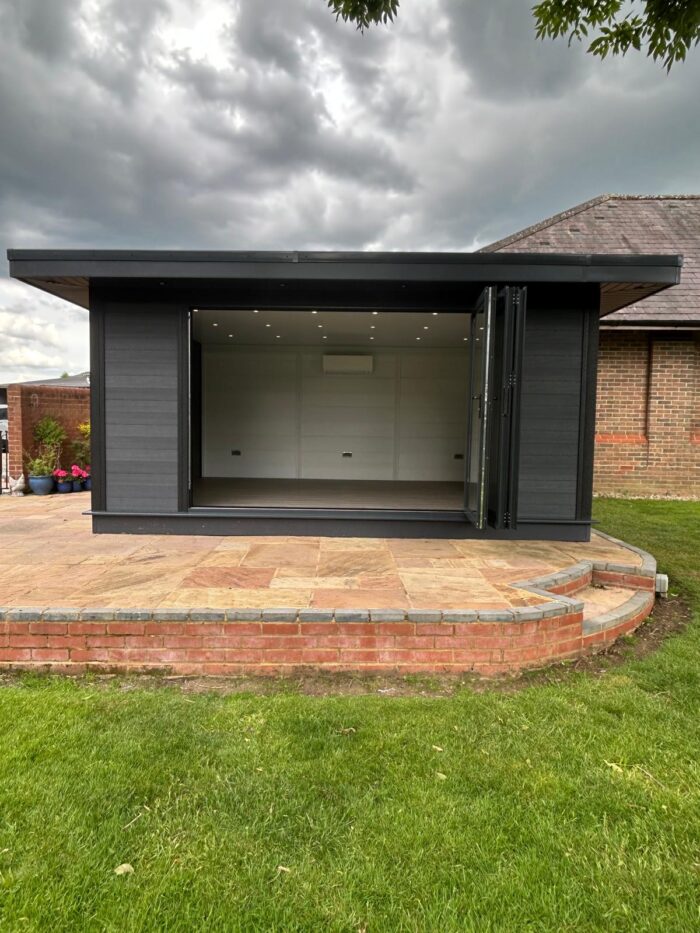
A garden gym in St Albans is a fully insulated garden room set up for training, giving you a private, year-round space to work out a few steps from the house rather than a drive across town. The two things that make or break a garden gym are the floor and the ventilation, because equipment is heavy and training generates a lot of heat and moisture. Get those right in a well-built, insulated composite room and you have a gym that is genuinely usable every day of the year, with no membership and no commute. We design, supply and install garden gyms across St Albans and the wider Hertfordshire area.
The appeal is mostly about consistency. From working with clients who train at home, we’ve found the biggest benefit is not the money saved on membership but the fact that a gym at the bottom of the garden gets used, because the friction of getting there disappears. When the walk to your workout is thirty seconds rather than a drive and a car park, the sessions that would otherwise be skipped actually happen. That is worth more than any single piece of equipment.
Can a garden room take the weight?
This is the first question most people ask, and rightly. A home gym can get heavy quickly once you add a rack, a bench, loaded barbells, a stack of plates and perhaps a treadmill or a functional trainer. The good news is that the load is spread across a fairly wide floor area rather than concentrated in one spot, which is exactly what a well-built floor is designed to handle.
Our rooms sit on a no-dig base built on a ground-screw and joist system, with a Styrofloor insulated floor over the top. For a gym with heavier equipment, or if you plan to do serious lifting, it is worth telling us at the design stage so the floor build-up is specified with that in mind rather than assumed. Where people intend to drop loaded barbells, additional protective flooring such as heavy rubber matting on top is essential, both to protect the floor and to manage noise and impact. We would rather plan the floor around how you actually train than leave it to chance.
Ventilation and temperature, the part people underestimate
Training changes the air in a room fast. You generate heat, you breathe harder, and you add a surprising amount of moisture through sweat and respiration, all in a relatively small sealed space. Without a plan for it, a garden gym can become uncomfortably warm in summer and prone to condensation, which is bad for both you and your equipment.
In our experience, a garden gym with air conditioning works better than one relying on an open door and a fan because it actively controls both temperature and humidity, keeping the room comfortable to train in and protecting metal equipment from the moisture that causes rust, whereas an open door alone leaves you at the mercy of the weather and lets that damp linger. Our rooms are fully insulated with double glazing, which keeps the base temperature stable, and openable windows help, but for a room used hard and often, air conditioning is the upgrade that makes the biggest difference. As a guide from our own range, it is typically an add-on from around £2,040 for a single unit. Good insulation also means the gym is warm enough to train in through winter without a lengthy warm-up of the room first.
Flooring done properly
Flooring in a gym does three jobs. It protects the structure beneath, it protects your equipment and your joints, and it manages noise and impact. The Styrofloor insulated base gives you a solid, level, insulated starting point, and on top of that the right surface depends on how you train.
For general fitness and cardio, interlocking rubber tiles or rolled rubber flooring is comfortable, hard-wearing and easy to clean. For free weights and lifting, thicker rubber matting in the lifting zone absorbs impact and protects everything underneath. For a studio-style space for yoga, pilates or bodyweight work, a cushioned or sprung finish is kinder for floor work. It is worth deciding your primary use before choosing, since a floor optimised for lifting is different from one optimised for movement.
Getting the size right
Size should follow your training. A compact 3.3m x 2.3m room suits a focused setup, such as a bike or rower with a small free weights area, or a dedicated yoga and stretching space. For a fuller home gym with a rack, a bench, cardio equipment and room to move safely around loaded bars, a wider 4.8m or 6.4m configuration makes a real difference, and headroom matters if you press overhead, so mention that early. Our largest standard room is 8m x 4.5m, and bespoke sizes are available if you want something specific.
Mirrors, storage for plates and dumbbells, and enough sockets for equipment and screens are all easier to plan in from the start than to add later. Our rooms include a first-socket electrical package with spotlights, wiring and a fuse box as standard, with additional sockets and upgrades available.
Private, and quiet enough not to annoy anyone
A garden gym gives you privacy that a busy commercial gym never will, which suits a lot of people who would rather train without an audience. It also keeps the clatter of weights and the noise of a treadmill out of the house. A composite room with insulated walls and a 100mm insulated roof already dampens a good deal of sound, and heavy rubber flooring in the lifting area cuts impact noise further. If you train early or late, or your garden sits close to a neighbour, mention it and the layout and flooring can be planned with that in mind.
Suited to St Albans gardens and built to last
Gardens across St Albans vary from compact plots behind period terraces to larger spaces with mature planting and uneven ground, and the ground-screw base copes with sloping or uneven sites without the excavation and mess of a concrete raft. The same practical strengths that apply to garden rooms in St Albans generally apply to a gym, with the added factors of floor loading and ventilation to plan for.
Because the composite cladding needs no painting, staining or sealing, the building looks after itself while you concentrate on training, and we back our rooms with a guarantee. An occasional wash down is all the exterior asks for.
Cost, build and planning
Our standard rooms start from around £9,714 supply-only or £12,096 fully installed for the smallest size, rising to roughly £29,845 installed for the largest standard size, with bespoke dimensions priced from the same system. We ask for a 50% deposit to begin production, delivery is typically four to six weeks, installation usually takes just three to four days on site, and delivery is free within a 70-mile radius of our EN2 0QX base, which covers all of St Albans.
Most garden gyms fall within permitted development, so planning permission is usually not required, though it is worth checking larger builds, boundary-close positions and any conservation-area restrictions against the official guidance on the Planning Portal. If you plan to train early or late near a boundary, that proximity is worth factoring in.
Plan your garden gym
If you want a private gym that gets used because it is right there, tell us how you train and we will plan the floor, ventilation and layout around it. You can explore our full range, request a callback at a time that suits you, or call us on 07816 898512.
You can also see finished rooms and build videos on our Facebook page and YouTube channel.