 Gable Roofed
 School Classroom
 Golf Room
 Snooker Room
 Home Office
 Home Gym
 Garden Annex
 Garden Studio
 Cinema Room
 Cocktail Bar
 Indoor Pool
 Beautician's Studio
 Café Area

Garden Room or Conservatory?
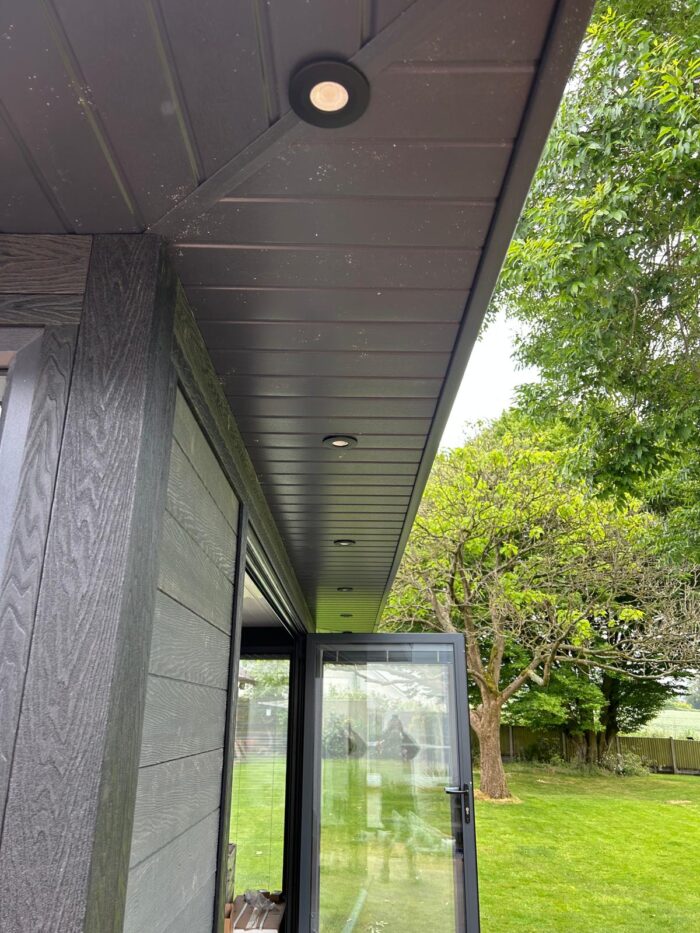
A conservatory is the better choice if you want extra space joined to the house with plenty of glass, while a garden room is the better choice if you want a separate, insulated room that stays comfortable all year. Most UK conservatories cost between £12,000 and £40,000 depending on size and specification, according to BookABuilder UK, while our insulated composite garden rooms start from around £12,096 fully installed.
Price is only part of the decision. A traditional conservatory is mostly glass, which is why so many swing from too hot in summer to too cold in winter. From working with clients across St Albans and Hertfordshire, we’ve found the most useful question is not which is cheaper, but where you want the room to be and how you want it to feel in January. This guide compares the two on cost, comfort, planning, building regulations and upkeep.
How do the costs compare?
Conservatory prices vary widely by frame material, style and roof. Home improvement site Less puts most UK projects between £8,000 and £25,000, with concrete strip foundations alone costing £1,500 to £3,500. Larger designs, hardwood frames and solid or tiled roofs push the figure higher, which is why some guides quote up to £40,000.
Our standard composite garden rooms start from around £9,714 supply only or £12,096 fully installed for a 3.3m x 2.3m room, rising to roughly £29,845 installed for our largest standard size at 8m x 4.5m. That price includes insulated walls, an insulated roof, double glazing, an insulated floor and an electrical package, with the ground screw base quoted separately. Because our rooms sit on a no dig base, there are no strip foundations to dig and pour.
Which is more comfortable all year?
This is the biggest practical difference between the two. A conservatory’s glass walls and roof let in a great deal of sunlight, which is lovely on a spring morning but can make the room unbearably hot on a summer afternoon. In winter, the same glass lets heat escape quickly. Less notes that without heating, a conservatory will be too cold to use comfortably from October to March, and older polycarbonate roofs make the problem worse. Large areas of cold glass are also where condensation tends to form.
A garden room is built the other way round, with solid insulated walls and roof and glazing placed where it is useful. Our rooms have fully insulated walls, an EPDM rubber coated 100mm insulated roof, a Styrofloor insulated floor and double glazed PVCu windows and doors. The room holds a steady temperature with a small heater in winter and stays far more stable on hot days.
In our experience, a garden room works better than a conservatory for a year round office, gym or studio, because the insulated walls and roof keep the temperature steady whatever the weather, whereas a mostly glazed conservatory gains and loses heat so quickly that it is hard to use comfortably for much of the year.
Joined to the house or separate from it?
A conservatory’s great strength is that it connects to the house. You step into it from the kitchen or living room, and it can feel like part of the home. That suits a dining area, a garden view sitting room or a space for plants.
A garden room’s strength is the opposite. It sits apart from the house, which makes it ideal for work, exercise, music or anything you want to keep separate from family life. Noise stays out of the house, and the short walk across the garden creates a clear line between work and home.
Planning permission
A conservatory attached to your home is treated as a house extension for planning purposes, so it must meet the permitted development limits for extensions on depth, height and position. A garden room is an outbuilding, which has its own set of limits on height, footprint and distance from boundaries. Both are explained in the government’s permitted development technical guidance.
St Albans has several conservation areas, where permitted development rights are more restricted. Whichever option you choose, it is worth checking your own address before you commit to a design.
Building regulations
Conservatories can be exempt from building regulations, but only while they meet specific conditions. As Ideal Home explains, the conservatory generally needs to be at ground level and under 30 square metres, separated from the house by external quality doors or walls, heated independently with its own controls, and glazed to safety standards. Remove the doors to make it open plan, or connect it to the main heating system, and full building regulations normally apply. New electrical circuits must comply with Part P either way.
Detached garden rooms used as an office, gym or studio are often outside building regulations too, depending on their size and position, but electrical work is notifiable in the same way. We are happy to talk through how this applies to the room you have in mind.
Upkeep and lifespan
A conservatory needs its glass cleaned inside and out, roof panels and gutters kept clear, and any timber frames treated. Many older conservatories end up needing a replacement roof to make them usable, which is a significant cost of its own.
Our composite cladding needs no painting, staining or sealing, and an occasional wash down is usually all it needs. The EPDM roof is durable and long lasting, and every building is backed by our guarantee.
When a conservatory makes more sense
A conservatory is the right choice if you want a bright room that opens straight off the house, mainly for daytime use in spring and autumn, and you are happy to accept that it will be warm in summer and need heating in winter. If you want space joined to the house but built to year round standards, a single storey house extension is the more direct comparison, though it costs considerably more.
When a garden room makes more sense
A garden room is the better fit if you want a room you can use comfortably every day of the year, a space that is separate from the house, or a building that goes up in days without foundations being dug against your back wall. Most of our rooms are installed in three to four days, with delivery typically four to six weeks from order and free within a 70 mile radius of our EN2 0QX base.
Talk it through with us
If you are torn between a conservatory and a garden room, the best starting point is how and when you will use the space. Modern Composite Garden Rooms can help you choose a size, layout and finish that works for your garden. Contact us, request a callback at a time that suits you, or call us on 07816 898512. You can also explore our full range.
To see finished rooms and installations, visit our Facebook page and YouTube channel.