 Gable Roofed
 School Classroom
 Golf Room
 Snooker Room
 Home Office
 Home Gym
 Garden Annex
 Garden Studio
 Cinema Room
 Cocktail Bar
 Indoor Pool
 Beautician's Studio
 Café Area
Is a garden room cheaper than a house extension?
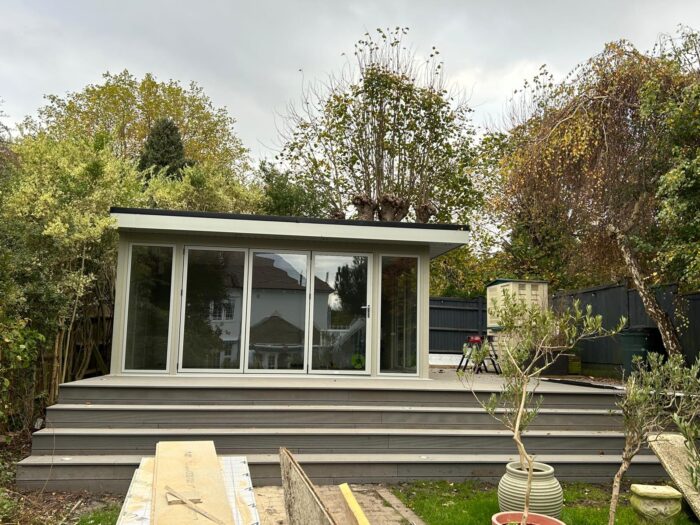
In most cases, yes, a garden room is cheaper than a house extension, often by a wide margin. A fully installed composite garden room typically costs from around £9,714 to £29,845 depending on size, whereas a single-storey house extension in the South East commonly runs into the tens of thousands and frequently well beyond, once you account for foundations, building regulations, professional fees and the disruption of building work attached to your home. If your main goal is more usable space for the lowest sensible cost, a garden room usually wins.
That said, the honest answer depends on what you are trying to achieve, because the two are not quite doing the same job. From working with clients who have weighed up both, we’ve found the decision rarely comes down to headline price alone. It comes down to whether the space needs to be part of the house, how quickly you need it, and how much upheaval you are willing to live through. A garden room and an extension solve overlapping but different problems, so the fairer question is which one fits your situation, and cost is only part of that.
Why a garden room usually costs less
Several things keep a garden room’s cost down compared with an extension. It sits on a no-dig base using ground screws rather than excavated foundations, which removes a large and unpredictable cost. It arrives as a pre-engineered, modular building rather than being constructed brick by brick on site, so labour time is far shorter. And it does not disturb the existing structure of your house, which avoids a whole category of complications and cost.
An extension, by contrast, involves foundations, structural work where it joins the house, matching brick and roofing, and full building regulations throughout. Each of those carries cost and time. There is nothing wrong with that spend when an extension is the right answer, but it explains why the two sit at very different price points for a similar amount of floor space.
What a garden room actually costs
Our standard composite garden room ranges start from around £9,714 supply-only or £12,096 fully installed for the smallest 3.3m x 2.3m size, rising to roughly £29,845 installed for the largest standard size at 8m x 4.5m, across sixteen standard configurations with bespoke sizes available. A fully installed price includes VAT and installation, fully insulated walls, an EPDM rubber-coated 100mm insulated roof, double-glazed PVCu windows and doors, a Styrofloor insulated floor and a first-socket electrical package with spotlights, wiring and a fuse box. The base and ground screws are quoted separately, since every garden differs.
Crucially, that is a largely known cost. Because so much of the building is specified and priced up front, there are fewer of the mid-project surprises that push extension budgets over. We ask for a 50% deposit to begin production, with the balance on completion, and delivery is typically four to six weeks.
Where extensions carry hidden costs
Extension budgets are notorious for growing, and it is usually the same culprits. Foundations can be deeper and more expensive than expected once the ground is opened up. Professional fees for an architect, structural engineer, planning application and building control add up before a single brick is laid. Party wall agreements may be needed if you are near a neighbour’s boundary. And knock-on works inside the house, redecorating, re-flooring and making good where old meets new, are easy to forget when comparing quotes.
None of this makes an extension a bad choice. It simply means the true, finished cost is often higher than the initial builder’s figure, and materially higher than a garden room delivering similar floor space.
Speed and disruption, the costs that are not on the invoice
There is a real difference in how the two projects feel to live through. A garden room is typically installed in just three to four days on site, at the bottom of the garden, away from your daily life. An extension can mean weeks or months of builders, dust, noise and a partially open house, sometimes with a kitchen or bathroom out of action for a stretch.
In our experience, a garden room works better than an extension for anyone who needs the space quickly and cannot face major disruption, because it is delivered and installed in days with the work kept out in the garden, whereas an extension ties up part of your home for weeks or months. Where an extension pulls ahead is when the space genuinely has to be part of the house, and we will come to that honestly.
When an extension is the better answer
It would be one-sided to pretend a garden room is always right, so here is the fair case for an extension. If you need the extra space to flow directly from your existing rooms, such as enlarging a kitchen or a living area, a garden room cannot do that, because it is a separate building across the garden. If you are adding bedrooms that must sit within the main house for how your family lives, an extension is the appropriate route. And an extension adds internal square footage to the house itself, which is reflected in the property in a particular way.
A garden room also uses up garden space, which an extension does not in the same way, so if your garden is small and precious, that trade-off matters. The right choice is genuinely situational.
What about adding value?
This is where people often expect a simple answer, and it deserves an honest one instead. Both a well-built garden room and a quality extension can make a property more attractive and more functional, but how each affects value depends on the property, the local market and the quality of the build, so it is not something anyone should promise you a figure on. A garden room adds flexible, self-contained space that many buyers now specifically look for, particularly for home working. An extension changes the internal footprint of the house itself. They are different propositions, and the sensible view is to choose primarily on the use you will get from the space, treating any effect on value as a secondary consideration rather than the deciding one.
The practical verdict
For most people wanting a home office, a gym, a studio, a hobby room or a self-contained space, a garden room delivers it faster, with less disruption, and at a lower and more predictable cost than an extension. An extension earns its higher cost when the space must be physically part of the house or must add bedrooms within it.
Our rooms are fully insulated for year-round use, need no painting, staining or sealing, and are backed by a guarantee, so the lower cost does not come at the expense of a building that lasts. Both routes usually involve planning considerations, and while most garden rooms fall within permitted development, it is worth checking size and boundary distances against the official guidance on the Planning Portal, especially in the conservation areas found around St Albans. The same considerations apply to garden rooms in St Albans as anywhere else.
Talk it through with us
If you are weighing a garden room against an extension, a quick conversation about what the space is for will tell you which makes sense. You can explore our full range, request a callback at a time that suits you, or call us on 07816 898512.
You can also see finished rooms and build videos on our Facebook page and YouTube channel.